
One common approach to assessing the impact of climate change on water resources involves using a limited set of scenarios derived from global climate models (GCMs). However, this method presents significant challenges—chief among them is the difficulty of assigning meaningful probabilities to these scenarios.
To address this issue, climate stress tests have been proposed. A climate stress test relies on the development of a climate response function that links climate information (e.g. change in temperature) to system performance indicators (e.g. hydropower generation, water supply reliability). The primary goal is to identify combinations of hydroclimatic stressors—typically variations in temperature and precipitation—that lead to system failure, i.e. when the system’s performance is unacceptable. Once these vulnerabilities are identified, targeted interventions can be proposed in a master plan.

To construct the climate response function, bottom-up stress tests typically require hundreds to thousands of synthetically generated hydroclimatic scenarios to comprehensively explore the system’s exposure space. One common technique involves modifying the statistical properties of historical climate data, which are then processed by a hydrological model to produce time series of river discharges. Data-driven methods can also be used generate a large number of synthetic streamflow sequences with given hydrologic properties.
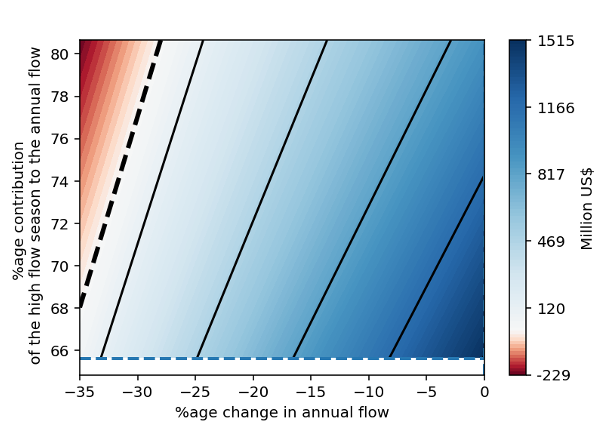
When a large number of GCM-based hydrologic projections is available, a third, hybrid approach can be employed. This approach involves constructing the response surface directly from the GCM projections, rather than relying on arbitrarily defined stressors or synthetically generated flow series.

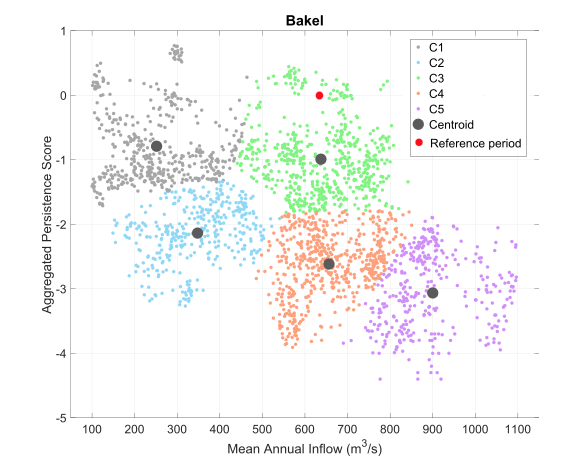
When conducting a stress test, it is essential to ensure that system performance is evaluated under adapted water allocation policies, rather than existing ones—which are likely to become obsolete as climate change alters flow regimes. However, determining optimal allocation policies for every possible combination of climate stressors can be computationally prohibitive in real-world applications as it requires implementing an optimization model. To address this challenge, we suggest grouping (clustering) hydrologic projections based on their key hydrologic characteristics.

This approach aims to identify potential alterations in flow regimes driven by climate change, allowing the development of climate-adapted allocation policies for each cluster, thereby reducing computational demands while maintaining relevance and accuracy. An additional benefit of this clustering method is that it shifts the framing of climate change from CO₂ emission scenarios to flow alterations, which are more intuitive for water managers to interpret and easier to accommodate when constructing narrative scenarios regarding the future of the river basin. An optimization model can then be used to determine the adapted allocation policies for each cluster using the centroid as the representative hydrological scenario. This hydrologically-driven approach has been implemented on several multireservoir systems in Quebec and in the Senegal River basin.
The next figure shows the adapted guide curve of the Kiamika Reservoir (Quebec) for a specific alteration of the flow regime due to climate change.

Articles
- Lachaut T. and A. Tilmant, 2021. Possibilistic response surfaces: incorporating fuzzy thresholds into bottom-up flood vulnerability analysis, Hydrol. Earth Syst. Sci., 25, 6421–6435. DOI: 10.5194/hess-25-6421-2021.
- Lachaut T., Yoon J., Klassert C. and A. Tilmant, 2022. Aggregation in bottom-up vulnerability assessments and equity implications: The case of Jordanian households’ water supply. Advances in Water Resources, 169, https://doi.org/10.1016/j.advwatres.2022.104311
- Sant’Anna C., Tilmant A. and M. Pulido-Velazquez, 2022. A hydrologically-driven approach to climate change adaptation for multipurpose multireservoir systems. Climate Risk Management, 36, https://DOI.org/10.1016/j.crm.2022.100427
- Sant’Anna C. and A. Tilmant, 2025. Designing decision-relevant partitions of the exposure space for the adaptation of reservoir operating policies under climate-change uncertainty. Canadian Water Resources Journal. http://dx.doi.org/10.1080/07011784.2025.2512787
- Espanmanesh V., Guilpart E., Bourgault M-A. and A. Tilmant, 2024. Adapting reservoir operation to climate change in regions with long-term hydrologic persistence. Climate Risk Management, https://doi.org/10.1016/j.crm.2024.100623