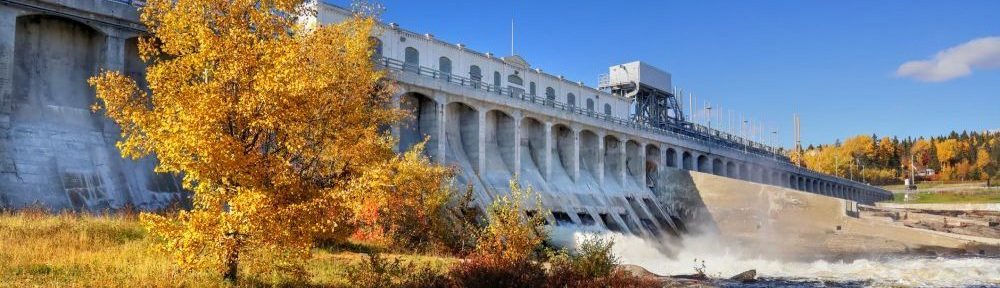
Water resources planning frequently entails the development of hydraulic infrastructure such as dams, hydropower plants, levees, pumping stations, and water transfer systems. Given their long operational lifespans—often spanning several decades or more—these structures are likely to be affected by climate change.
Because the water cycle is intricately linked to atmospheric conditions, any alteration in atmospheric composition will inevitably impact river flow regimes and natural aquifer recharge.

Climate change therefore raises two key challenges, depending on whether the infrastructure is already in place or still in the planning phase:
- How will existing hydraulic infrastructure perform under changing climatic conditions?
Many systems built in the 20th century were designed under the assumption of a stationary climate—a premise we now know to be outdated. Evaluating the resilience and performance of existing infrastructure under evolving climate scenarios is essential for developing effective adaptation measures. These may include revised operational policies. For instance, assessing the adaptive capacity of reservoir systems could offer a cost-effective alternative to expensive upgrades such as dam heightening.
Solution: Hydro-economic models (HEM) can be used to assess the performance of a water resources system under climate change. Optimization-based HEM are particularly useful to determine adapted operating/allocation policies to potential alterations of the flow regime. When imbedded into a climate stress test, HEM can also measure the adaptive capacity of a water resources system.
- What are the most robust investment strategies for future infrastructure, given deep uncertainty about the direction and magnitude of climate change?
In this context, “robust” refers to strategies that maintain acceptable performance across a wide range of possible future conditions, including variable water availability and demand. Investment planning may involve decisions about the selection, sizing, sequencing, and operational rules of infrastructure projects to ensure long-term flexibility and resilience.
Solution: We have developed a new framework for planning new water infrastructure in deeply uncertain environments based on Engineering Options Analysis (EOA). The framework differentiates between deep and statistical uncertainties and evaluates alternatives across thousands of potential future scenarios using Net Present Value (NPV) analysis and the Monte Carlo Temporal Analytic Hierarchy Process (MC-TAHP).

..